
Beyond the Search Bar
How Structured Data Prepares Your Business for the AI-First Web.
If you’ve been keeping an eye on digital marketing lately, you’ve probably heard terms like GEO (Generative Engine Optimisation) and AIO (AI Optimisation) thrown around alongside traditional SEO.
While the acronyms keep evolving, the core question for business owners remains the same:
“When a potential client asks an AI model like Perplexity, ChatGPT, or Google Gemini for a recommendation in my industry… does it cite my business, or my competitor?”
Search engines are no longer just looking at keywords—they are looking for trust, context, and proof.
We recently completed an overhaul of our clients’ digital Knowledge Graph, transforming the way machines “read” their websites. Here is a short breakdown of what structured data actually is, why it matters for your bottom line, and how it strengthens your digital authority.
What Is Structured Data (Schema Markup)?
Think of your website as a published book. A human visitor sees the beautiful formatting, the images, and the design layout.
An AI crawler or search engine, however, reads your site at hyper-speed. Structured data (often called Schema) is like providing that crawler with a universal index card for every page. It translates human content into plain, unambiguous code that machines can instantly verify.
Instead of guessing whether a page is about a service, a project, or an article, structured data explicitly tells the machine:
- Who created the work
- What specific services were delivered
- Which real-world problems were solved
- Where the verified proof lives
The Power of Connecting the Dots: E-E-A-T & GEO
Google evaluates content using a framework called E-E-A-T (Experience, Expertise, Authoritativeness, and Trustworthiness). Modern AI models use similar principles to decide which sources are reliable enough to cite in search summaries.
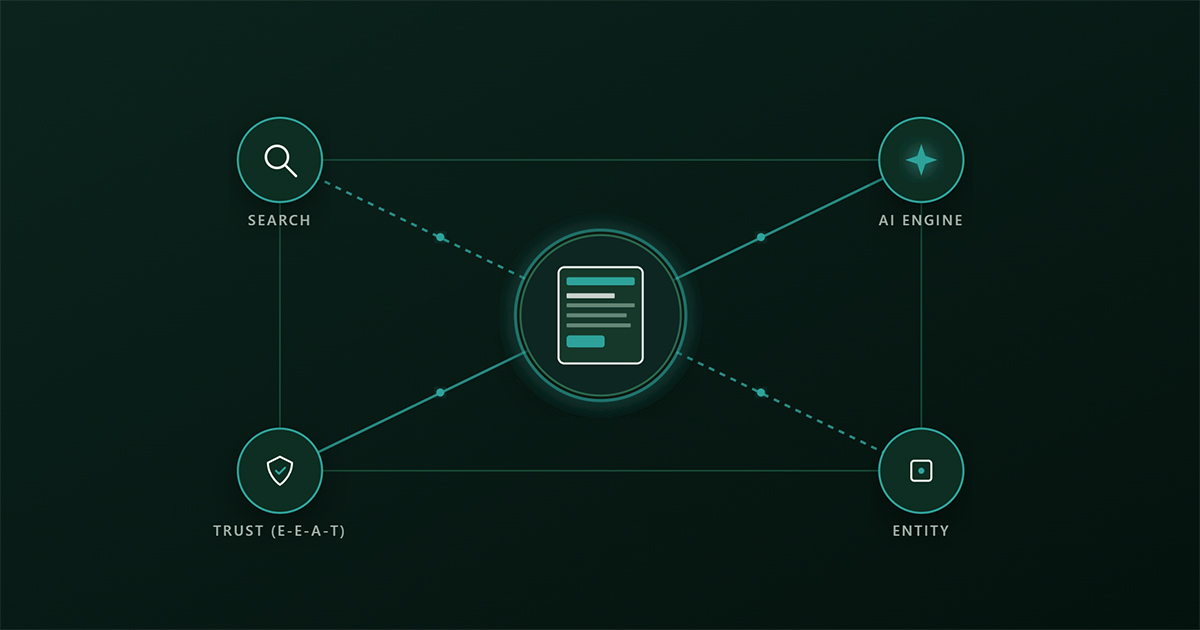
By structuring your data across your website, you create a connected Knowledge Graph. Here is what that achieves in practice:
1. Real-World Proof Linked Directly to Your Services
If you offer a specialised service, having a page that describes it is only step one. By linking your real-world case studies directly to your core service offerings in machine-readable code, you prove to search engines that your service claims are backed by actual past performance.
2. Protecting Privacy While Demonstrating Impact
Working under strict NDAs or enterprise confidentiality? You don’t need to sacrifice privacy for visibility. Structured data allows you to highlight real-world results – like a 75% reduction in digital carbon emissions – while keeping sensitive client identities completely anonymised.
3. Establishing Human Expertise
AI models value content created by recognised, real-world experts. By explicitly linking named team members to specific technical audits and project case studies, you anchor your firm’s human talent directly into the machine’s knowledge base.
4. Turn Archives into Comprehensive Knowledge Hubs
Instead of leaving portfolio pages or case study indexes as simple lists of links, structuring them as an active “Collection” gives AI engines a complete directory of your authority across different sectors—from enterprise technology to sustainable digital design.
What This Means for Your Business Growth
Investing in structured data isn’t just a technical exercise – it delivers real commercial advantages:
- Future-Proofed Digital Assets: Prepares your website for the next generation of web discovery without requiring a complete design rebuild.
- Higher Visibility in AI Answers: When potential clients ask AI tools for recommendations or solutions in your niche, structured data gives those engines the confidence to cite your work accurately.
- Stronger Search Engine Trust: Eliminates ambiguity about who you are, what you do, and who is behind the brand.
Ready to Upgrade Your Site’s Knowledge Graph?
Let’s collaborate and transform your site into an enterprise-grade digital powerhouse.

